I've just begun reading Bill Bryson's The Lost Continent: Travels through small town America.
After what is a standard beginning for most books--acknowledgements, publication, dedication and title (each prescribed with a miniscule roman numeral)--Bryson's prose begins on page three. By page seven he has managed to successfully coerce an audible laugh from me (which, when you're reading amidst a group of people in a crowded shop is a commendable feat in itself), and bring me to a place it seems all young kids avouch for early recognition of the larger world around them: National Geographic.
Though Elizabeth Bishop certainly published this notion years ago, its validity remains universal without epic or further publication; I am writing here, in an untrafficked place, with my own modest memory of the magazine.
I played piano from the age of six until I was a sophomore in high school, and practicing the keyed instrument was my least favorite part of the day. I'd tinker with Bach's Minuet in G, and thereafter avoid my Suzuki book entirely. Instead, I supplemented the classics with rags or jazz I'd memorized months or years before, and afterward, would slip from the corduroy cushion on its bench to the storage cupboards next to the piano. In addition to old photo albums from my parents' college years, the cupboards housed an archive of National Geographics aligned by date. Their spines created an overwhelming rectangle of gold when I climbed atop the bar's counter to open the narrow door next to the windows of the wine cabinet.
One afternoon, as I avoided Vivaldi and went to the cupboard, a Kayan woman with golden rings around her neck stared at me through the golden frame of the cover. As a child of probably six or seven, I was astonished. The necks of her and the other women were "wound round and round with wire like the necks of light bulbs". Sitting cross-legged on the carpet and devouring other photos of the giraffe woman, I didn't understand the physics or the medical nightmares that occurred when the clavicles of the woman were crushed and the apparatus rendered her neck muscles so weak they could no longer support her head without the device. This beauty was painful, but I only imagined the place in which she resided. It was so far removed from anything I'd ever seen, its actual existence was unfathomable.
When I asked my mother about it, I'm sure her reply was something about other cultures having different perceptions of beauty--which is why even the small children in the magazine had pierced ears and I had to wait until my eighth birthday to have my lobes punctured. But I considered myself lucky because my best friend Karen was waiting until thirteen, an age tardy by both her standards and mine.
When my time came, I discovered my allergy to nickel and other inexpensive metals and the healing process had been a mess. My ears became pussy, bloody and painful when I exchanged my original stainless steel studs with golden ballerinas, and, from then on, I was forced to don the plain jewels reserved by the "sensitive ears" section of Claire's.
But I've digressed from the point.
The floundering magazine that was created in 1888 to increase the "diffusion of geographic knowledge" was supported by Alexander Graham-Bell's father-in-law, and originally read like a textbook. It wasn't until photographs were a haphazard addition to an edition in 1905 that our country, from Bill Bryson and Elizabeth Bishop, became and remained entranced by the worlds in its pages they would have otherwise never been able to see. And that's where Bryson left off when I bookmarked page fourteen to write this: with his desire to leave his hometown of Des Moines, Iowa and move to England. And he did. But his following pages are not of the places he discovered in his years abroad; they are a rediscovery of our own and his own small town escapades.
But perhaps I'm making a grandiose statement prematurely. Giving a book fourteen pages is like judging its cover, even though I'm looking forward to giving Bryson a few more days.
" I began to read--no, I began to consume--National Geographics, with their pictures of glowing Lapps and mist-shrouded castles and ancient cities of infinite charm. From that moment, I wanted to be a European boy. I wanted to live in an apartment across from a park in the heart of a city, and from my bedroom window look out on a crowded vista of hills and rooftops. I wanted to ride trams and understand strange languages. I wanted friends named Werner and Marco who wore short pants and played soccer in the street and owned toys made of wood. I wanted my mother to send me out to buy long loaves of break from a shop with a wooden pretzel hanging above the entrance. I wanted to step outside my front door and be somewhere."
Showing posts with label Literature. Show all posts
Showing posts with label Literature. Show all posts
Saturday, May 24, 2008



Wednesday, April 2, 2008
So my literary nonfiction professor assigned a few blogs for our reading tomorrow, and, in addition, wanted us to bring a few postings from blogs we currently read. I figured that on the off chance any of the people in my class would somehow end up here, they should have something to read other than the rehashings of my newspaper column I occasionally post.

But after such an image, that I yes, constructed and shot with my own camera, they'll probably never return and/or think me some other kind of unmentionable crazy.
Seeing these outcomes are rather unfortunate for both my readers and me, perhaps I'll admit the entire event was an insouciant escapade and that I'd forgotten how heavy wet snow is.

But after such an image, that I yes, constructed and shot with my own camera, they'll probably never return and/or think me some other kind of unmentionable crazy.
Seeing these outcomes are rather unfortunate for both my readers and me, perhaps I'll admit the entire event was an insouciant escapade and that I'd forgotten how heavy wet snow is.
Friday, March 14, 2008
From a work still in the works.
I just thought I would share a scene from a larger piece I'm currently working on about growing up Catholic.
From "Of Catechism and Crosses"
As a kid in the church, my involvement began with the children’s choir and vacation bible school, culminating in the fifth grade, when I was allowed to begin altar serving. For years I’d watched older kids bring the chalice and water and wine to the right place at the right time, and I was itching to climb the stairs and sit next to Fr. Ed on the altar. Even more, I was anticipating a look into the “back room” – the sacristy – where only servers, lectors and priests were privy.
The first mass I served was a cool morning in September, and like any other event in my life, the whole family – grandma included – had come. She warbled when she sang, and throughout my childhood managed enjoyably to bring her volume above everyone else in the church. I was pleased that I would hear her praises from a distance. The mass began like any other; five minutes before, I lit the candles and after the lector welcomed everyone and invited the congregation to “stand and greet those” around them, I pretentiously took the church’s steel cross out of its stand for the opening procession. I banged it on the doorframe of the sacristy and turned red, grateful that everyone was standing and only a few could see the scene. The song continued and I struggled to carry the cross up the aisle. At twenty-one I tower just past five feet, and as an eleven year old I was wrestling a giant with spaghetti for arms. The cross teetered forward and backward and I grit my teeth as I staggered up the stairs at the end of the song.
Placing the cross in its stand was like threading a needle. Its post was round but scarcely an inch in diameter. To support the rest of its heavy shape, its stand – a round tube just larger than the diameter of the cross – rose nearly a foot off the ground. With the cross's top towering over my head I stabbed at the stand and missed to the left, then clanked it too far forward. I had broken a sweat by the time I wiggled the cross back and forth and the friction of steel on steel met its post with support. The service began and I flawlessly held the gigantic book for the opening prayer; the lector read and the choir sang the responsorial psalm.
While my success had been limited up to this point, I had made a cardinal mistake as an altar server. The morning had been cool and I’d chosen a wool sweater to wear beneath my cassock. As the mass continued on, my insulating layers cooked like a crock pot. The intensity of the heat came in waves, and waves of nausea came with its intensity. My face was a lobster and my hands clams. I ran their sweaty surfaces down my thighs and slowed my breathing. Just relax, Kelsey. Get through the mass and you’ll be fine. You’re just nervous.
And then I was swept with the feeling you get just before you vomit. Your muscles drain themselves of power and you tend to shake like you’ve just run a marathon. Your mouth goes dry like you’ve swallowed soda crackers without water.
Was I going to ruin my years of anticipation as an altar server? Not if I could help it. I stood my ground and swallowed gingerly. And swallowed again. And closed my eyes.
As I perched on the bench next to Fr. Ed’s ornate chair and he delivered his homily, I kneaded my palms and then clenched my fists while the congregation took no apparent notice of my struggle that went something like this: The crackers, the marathon. The crackers, the marathon. Lobster face. Clams. Lobster face. Crackers. Clams. Marathon. Face. Clams. Crackers.
I couldn’t swallow.
But I couldn’t leave my post and abandon my responsibility. I was only eleven, and what was this going to say about slacking off and its relation to the rest of my life? Somebody still needed to symbolically pour the water over Fr. Ed’s hands before the consecration. And I knew how to do it and wasn’t going to leave him out to dry.
But I had a marathon in my muscles and clams in my hands and…
I lost the battle as my breakfast hit my shoes.
I ran to the Sacristy. My mother met me there as tears of stress from both vomiting and sadness squeezed between my eyelids. “I’ve ruined the mass!” I sobbed, “And there’s puke all over the carpet up there!”
Mom took me home and Dad stayed after mass to apply vinegar and water to the soiled, gray carpet of the altar. We dry-cleaned my white cassock, and I could never figure out how my mother was allowed to come back to the sacristy without permission.
From "Of Catechism and Crosses"
As a kid in the church, my involvement began with the children’s choir and vacation bible school, culminating in the fifth grade, when I was allowed to begin altar serving. For years I’d watched older kids bring the chalice and water and wine to the right place at the right time, and I was itching to climb the stairs and sit next to Fr. Ed on the altar. Even more, I was anticipating a look into the “back room” – the sacristy – where only servers, lectors and priests were privy.
The first mass I served was a cool morning in September, and like any other event in my life, the whole family – grandma included – had come. She warbled when she sang, and throughout my childhood managed enjoyably to bring her volume above everyone else in the church. I was pleased that I would hear her praises from a distance. The mass began like any other; five minutes before, I lit the candles and after the lector welcomed everyone and invited the congregation to “stand and greet those” around them, I pretentiously took the church’s steel cross out of its stand for the opening procession. I banged it on the doorframe of the sacristy and turned red, grateful that everyone was standing and only a few could see the scene. The song continued and I struggled to carry the cross up the aisle. At twenty-one I tower just past five feet, and as an eleven year old I was wrestling a giant with spaghetti for arms. The cross teetered forward and backward and I grit my teeth as I staggered up the stairs at the end of the song.
Placing the cross in its stand was like threading a needle. Its post was round but scarcely an inch in diameter. To support the rest of its heavy shape, its stand – a round tube just larger than the diameter of the cross – rose nearly a foot off the ground. With the cross's top towering over my head I stabbed at the stand and missed to the left, then clanked it too far forward. I had broken a sweat by the time I wiggled the cross back and forth and the friction of steel on steel met its post with support. The service began and I flawlessly held the gigantic book for the opening prayer; the lector read and the choir sang the responsorial psalm.
While my success had been limited up to this point, I had made a cardinal mistake as an altar server. The morning had been cool and I’d chosen a wool sweater to wear beneath my cassock. As the mass continued on, my insulating layers cooked like a crock pot. The intensity of the heat came in waves, and waves of nausea came with its intensity. My face was a lobster and my hands clams. I ran their sweaty surfaces down my thighs and slowed my breathing. Just relax, Kelsey. Get through the mass and you’ll be fine. You’re just nervous.
And then I was swept with the feeling you get just before you vomit. Your muscles drain themselves of power and you tend to shake like you’ve just run a marathon. Your mouth goes dry like you’ve swallowed soda crackers without water.
Was I going to ruin my years of anticipation as an altar server? Not if I could help it. I stood my ground and swallowed gingerly. And swallowed again. And closed my eyes.
As I perched on the bench next to Fr. Ed’s ornate chair and he delivered his homily, I kneaded my palms and then clenched my fists while the congregation took no apparent notice of my struggle that went something like this: The crackers, the marathon. The crackers, the marathon. Lobster face. Clams. Lobster face. Crackers. Clams. Marathon. Face. Clams. Crackers.
I couldn’t swallow.
But I couldn’t leave my post and abandon my responsibility. I was only eleven, and what was this going to say about slacking off and its relation to the rest of my life? Somebody still needed to symbolically pour the water over Fr. Ed’s hands before the consecration. And I knew how to do it and wasn’t going to leave him out to dry.
But I had a marathon in my muscles and clams in my hands and…
I lost the battle as my breakfast hit my shoes.
I ran to the Sacristy. My mother met me there as tears of stress from both vomiting and sadness squeezed between my eyelids. “I’ve ruined the mass!” I sobbed, “And there’s puke all over the carpet up there!”
Mom took me home and Dad stayed after mass to apply vinegar and water to the soiled, gray carpet of the altar. We dry-cleaned my white cassock, and I could never figure out how my mother was allowed to come back to the sacristy without permission.
Wednesday, February 13, 2008
In praise of the Harper's gods.
This month's edition of Harper's has now saved my life twice in the last twenty four hours. Please note my Mass Comm 1001 assignment below. (As you may have read a few weeks ago, my loathing for the class remains. James Frey and A Million Little Pieces was cited for the zillionth time in a classroom as unethical. However, this time a bright student raised his hand and said, "It was so popular because it was so graphic, and helped so many people, and Oprah loved him, and then it was like, what the hell?" But in redeeming light of this, I got to defend the status of the published word in society this week. Admittedly, it's rather melodramatic.)
As an English major considering the decline of physical books, my instincts are to cringe and quell the concept entirely. Call me a fan of the old fashioned; I prefer a pen and paper to digital media and I don’t even own a television. However, as a technical savvy individual, my older brother keeps his e-books on his iphone and praises its capability and accessibility. “Staying Awake, Notes on the alleged decline of reading,” was published in Harper’s this month and speaks directly to the subject. In her first paragraphs, Ursula K. LeGuin writes, “In 2004, a National Endowment for the Arts survey revealed that 43 percent of Americans polled hadn’t read a book all year, and last November, in its report, ‘To Read or Not to Read,’ the NEA lamented the decline of reading, warning that non-readers do less well in the job market and are less useful citizens in general.” She continues her discourse to discuss the social qualities of literature. While she criticizes the written quality of published books, citing Harry Potter as an anomaly to the situation, she notes the “social quality of literature is still visible in the popularity of best-sellers.” Though we are reading less on a whole, books are not obsolete. It is the publishers who are getting away with “making baloney-mill novels” popular. So, physical books remain a commodity, even if by publishing standards a “good book” is merely something that will sell instead of a creation of prose with substance.
But concerning the e-book. Companies like Google that have recently placed scanned versions of rare books online are properly taking advantage of what digital media can offer a reader. It aids research and yields access to works that would otherwise be left unutilized by the ordinary person in society. Having used Google’s collection of books myself, I can attest that I would not have found a copy of Rhetoric and Wonder in English Travel Writing, 1560-1613 by Jonathan Sell in any other library. This volume selects the exact time period that John Donne was composing much of his literature, and specifically a poem titled: “Good Friday 1613. Riding Westward.” Donne’s wonder of God as a traveler was exactly the premise of the essay I was writing. It was like I had struck gold.
We gaze at LCD screens and the glow of our computers and Blackberrys for hours on end to check e-mail and read articles, and in my case, write them. The radio is even streaming online. I’d prefer give my eyes a rest and read several hundred pages of text in a chair and in physical form. There is something to be said about holding a physical copy of a book in one’s hands; I believe physical books to be a large element of Intellectual Property. Because the Internet remains so accessible, and books like Jonathan Sell’s are not only available but copyrighted, pirated materials are ubiquitous. As a writer, there is something to be said about having a physical copy of your work in your hands. While publishing online makes one’s work accessible, it also give the author a less tangible sense of accomplishment.
The nation still flocks to the National Archives in Washington D.C. to gaze at the original copy of the Declaration of Independence. While we can look at a replica or photograph of this document’s brittle page over the Internet, it will not suffice for the actual document itself. We are not creating icons like the Declaration with the use of the Internet, as what is published only online does not manifest physically. If we continue to rely upon an abyss of invisible networks we will lose a tangible sense of creation within society.
As an English major considering the decline of physical books, my instincts are to cringe and quell the concept entirely. Call me a fan of the old fashioned; I prefer a pen and paper to digital media and I don’t even own a television. However, as a technical savvy individual, my older brother keeps his e-books on his iphone and praises its capability and accessibility. “Staying Awake, Notes on the alleged decline of reading,” was published in Harper’s this month and speaks directly to the subject. In her first paragraphs, Ursula K. LeGuin writes, “In 2004, a National Endowment for the Arts survey revealed that 43 percent of Americans polled hadn’t read a book all year, and last November, in its report, ‘To Read or Not to Read,’ the NEA lamented the decline of reading, warning that non-readers do less well in the job market and are less useful citizens in general.” She continues her discourse to discuss the social qualities of literature. While she criticizes the written quality of published books, citing Harry Potter as an anomaly to the situation, she notes the “social quality of literature is still visible in the popularity of best-sellers.” Though we are reading less on a whole, books are not obsolete. It is the publishers who are getting away with “making baloney-mill novels” popular. So, physical books remain a commodity, even if by publishing standards a “good book” is merely something that will sell instead of a creation of prose with substance.
But concerning the e-book. Companies like Google that have recently placed scanned versions of rare books online are properly taking advantage of what digital media can offer a reader. It aids research and yields access to works that would otherwise be left unutilized by the ordinary person in society. Having used Google’s collection of books myself, I can attest that I would not have found a copy of Rhetoric and Wonder in English Travel Writing, 1560-1613 by Jonathan Sell in any other library. This volume selects the exact time period that John Donne was composing much of his literature, and specifically a poem titled: “Good Friday 1613. Riding Westward.” Donne’s wonder of God as a traveler was exactly the premise of the essay I was writing. It was like I had struck gold.
We gaze at LCD screens and the glow of our computers and Blackberrys for hours on end to check e-mail and read articles, and in my case, write them. The radio is even streaming online. I’d prefer give my eyes a rest and read several hundred pages of text in a chair and in physical form. There is something to be said about holding a physical copy of a book in one’s hands; I believe physical books to be a large element of Intellectual Property. Because the Internet remains so accessible, and books like Jonathan Sell’s are not only available but copyrighted, pirated materials are ubiquitous. As a writer, there is something to be said about having a physical copy of your work in your hands. While publishing online makes one’s work accessible, it also give the author a less tangible sense of accomplishment.
The nation still flocks to the National Archives in Washington D.C. to gaze at the original copy of the Declaration of Independence. While we can look at a replica or photograph of this document’s brittle page over the Internet, it will not suffice for the actual document itself. We are not creating icons like the Declaration with the use of the Internet, as what is published only online does not manifest physically. If we continue to rely upon an abyss of invisible networks we will lose a tangible sense of creation within society.
Friday, December 21, 2007
Brimnes and Bill Holm
Bill Holm makes me want to move to Iceland. Really.
On my first of three errands to West Photo yesterday, (Three, because the "printing technichian" thought I wouldn't know the difference if they cropped the foreground, sideground, background - basically anything other than the subject in my photo - in order to cram the frame uncomfortably into an 8x10 that makes me look terribly inept as a photographer. All I wanted was an 8x12 - but I had to bring them back of course. Thank God its only a five minute drive.) I was listening to MPR - and the entire morning was a discourse about fetal alcohol systematic disorders. Long story short - there hasn't been a minimal safe tolerance of alcohol established for pregnancy. Bottom line: don't drink while you're pregnant. But one snipt did jingle my ear - Bill Holm was to be on at noon.
My solace in his writing came from his collection of essays, Coming Home Crazy. It was recommended to me after I went crazy, too, during a little period of readjustment back in June. The book is a series about a year long endeavor teaching English in China, and it was a comfort to know I wasn't an anomaly and that Guatemalan banks aren't the only places that change their rules from day to day. Perhaps I love him a little.
I love being read to, and I've always wondered why we quit reading to one another after we gain the skill on our own. Why is reading silently such a big deal in elementary school? Why did I get pissed when the kid next to me wasn't really reading silently, but muttering the words under his breath?
But I do remember the seventh grade. Mrs. Johnson was my English teacher and she opened every class with a few pages or a chapter from The Outsiders. It was one of the best times - and one of the only times in English class in junior high that I remember. The buildling was old - most Catholic schools are - and we sat at hexagonal tables in the room, four or so to a table. Mrs. Johnson, a middle-aged woman with gray-blonde hair, sat in her directors chair when she read - mostly because she was scarcely five feet and it was more comfortable than the slate backed, pastel seats of the room. Her voice matched her stature, and I'd sit and gaze up at the cork board borders of the room, considering Ponyboy and his gang. And she frustratingly stopped at the most inopportune moments. But that was, of course, intnetional on her part.
So I opend my ibook and tuned in and stopped answering my phone. For an entire hour. And a 65 year old author with a raspy, velvet voice read poetry about small town patriotism and Walt Whitman's Brooklyn Ferry. And he told me about Iceland. Which, as it happens is the subject of his latest work, Windows of Brimnes. He spoke of its intricate and beatiful language and its cake-frosting houses by the sea. "Almost everything in the country is within spitting distance of it," he said.
He spoke of not having an address - but living in a place where people can find you if they ask. Where windows are open to the evening tide and houses hold old Steinways and conversation. His home sits quietly in a crag and he keeps computers away from it.
And he read of his mother, and Icelandic woman from America who spoke the language well. He putters through sentences.
But in English, he made me wish for travel again.
On my first of three errands to West Photo yesterday, (Three, because the "printing technichian" thought I wouldn't know the difference if they cropped the foreground, sideground, background - basically anything other than the subject in my photo - in order to cram the frame uncomfortably into an 8x10 that makes me look terribly inept as a photographer. All I wanted was an 8x12 - but I had to bring them back of course. Thank God its only a five minute drive.) I was listening to MPR - and the entire morning was a discourse about fetal alcohol systematic disorders. Long story short - there hasn't been a minimal safe tolerance of alcohol established for pregnancy. Bottom line: don't drink while you're pregnant. But one snipt did jingle my ear - Bill Holm was to be on at noon.
My solace in his writing came from his collection of essays, Coming Home Crazy. It was recommended to me after I went crazy, too, during a little period of readjustment back in June. The book is a series about a year long endeavor teaching English in China, and it was a comfort to know I wasn't an anomaly and that Guatemalan banks aren't the only places that change their rules from day to day. Perhaps I love him a little.
I love being read to, and I've always wondered why we quit reading to one another after we gain the skill on our own. Why is reading silently such a big deal in elementary school? Why did I get pissed when the kid next to me wasn't really reading silently, but muttering the words under his breath?
But I do remember the seventh grade. Mrs. Johnson was my English teacher and she opened every class with a few pages or a chapter from The Outsiders. It was one of the best times - and one of the only times in English class in junior high that I remember. The buildling was old - most Catholic schools are - and we sat at hexagonal tables in the room, four or so to a table. Mrs. Johnson, a middle-aged woman with gray-blonde hair, sat in her directors chair when she read - mostly because she was scarcely five feet and it was more comfortable than the slate backed, pastel seats of the room. Her voice matched her stature, and I'd sit and gaze up at the cork board borders of the room, considering Ponyboy and his gang. And she frustratingly stopped at the most inopportune moments. But that was, of course, intnetional on her part.
So I opend my ibook and tuned in and stopped answering my phone. For an entire hour. And a 65 year old author with a raspy, velvet voice read poetry about small town patriotism and Walt Whitman's Brooklyn Ferry. And he told me about Iceland. Which, as it happens is the subject of his latest work, Windows of Brimnes. He spoke of its intricate and beatiful language and its cake-frosting houses by the sea. "Almost everything in the country is within spitting distance of it," he said.
He spoke of not having an address - but living in a place where people can find you if they ask. Where windows are open to the evening tide and houses hold old Steinways and conversation. His home sits quietly in a crag and he keeps computers away from it.
And he read of his mother, and Icelandic woman from America who spoke the language well. He putters through sentences.
But in English, he made me wish for travel again.
Saturday, November 11, 2006
Tejutla. March, 2004.
I apologize for the poor formatting of this piece. But of course, text and formatting doesn't transfer when you paste a word document. The original contains particular formatting elements that identify people or official information. You'll have to bear with me as I attmpet to sort it out without an ability to format text. I wrote this in the fall of 2005, about a year after I first traveled to Guatemala. The dated pieces are exerpts from my journal during my time there, and most of all my other documentation is cited accordingly. The direct quotes are my father speaking.
“In the early 1980’s, Guatemala was involved in a civil war with the northern highlands being one of the major centers of conflict. Because of the war and the remoteness of the location, the local populations had virtually no transportation, communication or medical assistance. Many communities were without food, potable water, electricity, and many families were displaced.” (HELPS International www.helpsintl.org)
HELPS international is a Christian based, non-profit organization that works in the villages of Guatemala, in an attempt to aid the country’s people in medical need. Originating in Texas, and sending its first medical team in 1984 in the midst of the still raging war, HELPS has grown to send ten to twelve teams each year and had collectively given over sixty million dollars worth of service to the Guatemalan people. The capability of each fifty-member team has reached full plastic and reparative surgery, a general practice, and fully functioning dentistry effort. Over the span of one week in a village, each team completes over 100 surgeries, sees more than 1300 patients in the clinic and provides around 700 dental procedures.
“I got involved because I was asked to.”
"Bruce Kudak, D.D.S. Dr. Kudak is the head of HELPS’ dentistry effort. From St. Cloud, MN he went on his first medical team in 1995. Since then, he has been deeply involved with the HELPS medical program and has been on the leadership board since 1998. Through his work, this critical area of medical assistance is fully mobile, which allows for dental surgery and dental restoration in the hospital or in the field." (www.helpsintl.org)
My father finally gave into the urging of his long-time anesthesiologist friend, Dr. Gary Boeke, and traveled for the first time to the highlands of Guatemala when I was a second grader. Remembering this, I’m not entirely sure he knew that when he would begin a kind of work more gratifying than any he’d done before. The highlands of this small country, whose boundaries are slightly smaller than that of Tennessee, remained torn after guerilla and political warfare had destroyed much of what the people had called their own over the previous thirty-six years. He came home for the first time, in March of 1995 with stories of children needing plastic surgery to defuse their hands after falling into open cooking fires in their one-roomed, cement houses, and of small men having “fallen off their farms” in an attempt to procure agriculture on the sides of the mountains. The people, mostly of indigenous decent were grateful, he said, even if he had extracted six permanent and rotting teeth. The children, whose teeth decayed from chewing on sugar cane, showed brilliant smiles at the brightly colored toothbrushes and toys he had brought for them. He was different, somehow, when he returned - perhaps more humble. Bringing jade for my mother and leather belts for my brothers, there was a new kind of care to his smile. I replaced my shirt with the brilliantly woven huipil (wee-peal) he carried home to me, and knew that he would travel again, perhaps someday taking me with him.
“You know there’s something pretty powerful about being on team like that, Kelsey, and forgetting about where you came from and what you do, and helping someone less fortunate.”
I’d heard my father say this each time he recalled his time in that beautiful country. Exposing and developing countless rolls of film during his trips, he captured the faces of the people and their beautiful color and kinship. Looking constantly at the albums he’d accumulated and watching my older brother make three trips before me, my time finally had arrived in my junior year of high school. Two years after I made the journey out of the United States into a country where “foreign” doesn’t begin to describe, I often remain lost in my memories of the brown, joyful faces I found among the dusty roads and primitive hospital structure in the village of Tejutla (Te-hoot-la), Guatemala.
--------------------------------------------------------------------------------------------
“Penny for your thoughts…” my father’s dentist friend Bill Moilanen says to me, pulling me from my awed trance that had been aimed through the bus window. A Michigan native from Flint and sitting behind me, he is curious to know of the electric sparks pulsing through my brain as the bus pulls out of the raging traffic of Guatemala City and heads for the dirt roads of the countryside. I had been wide eyed as a baby following a circling fan, and been desperately attempting to think of the way to convey my thoughts in Spanish, as he interrupted me in my fluorescently upholstered seat. I can’t begin to answer, as I glance back through the pane. A truck with a wooden fence on the attached to the wagon passes us on the unguarded mountainside road. Its back end is filled with Guatemalans pressed tightly together, and a small man of thirty or so, dressed in dusty jeans and a white buttoned shirt, smiles and winks at me as my widened eyes stare blankly back.
Tuesday 3-28-04, 7:08 PM
There is not one person who couldn’t need a doctor, or medication.
They live literally in poverty, yet they seem so happy.
Perhaps it’s what we bring to them – perhaps it’s just their spirit.
I knew what it was going to be like.
I’d heard the stories and seen the pictures.
But now that I’m here amongst it all and enveloped in it, it’s overwhelming.
I have to keep reminding myself that this is their life.
They don’t get on a plane in seven days and fly home to four cars with ipods, dancing, private school…
they might not see any of that in their lifetimes.
It’s my everyday life.
"The distribution of income and wealth remains highly skewed. The wealthiest 10% of the population receives almost one-half of all income; the top 20% receives two-thirds of all income. As a result, about 80% of the population lives in poverty, and two-thirds of that number--or 7.6 million people--live in extreme poverty. Guatemala's social development indicators, such as infant mortality and illiteracy, are among the worst in the hemisphere." (U.S. Department of State)
I walk into the dental clinic one afternoon, and greet the line of people on the benches outside holding their numbers and slips of papers containing names, ages, birth date and their ailment. They are hoping to have mere moments with either my father or Bill. As I take a left in to Bill’s room from the hallway, I help him to prepare instruments for an extraction as we wait for Novocain to take effect on a boy of about twelve. After the procedure as he comps on a wad of gauze where his tooth had been, he smiles at me with his dark brown eyes and holds his hands behind his back, hiding something from my sight. Asking him in Spanish what it is, he grins and holds out a quetzal, a coin valued at sixteen cents, up toward the light. I begin a guessing game with him about the currency’s production year and finally guess “dos mil” (2000). When he proclaims “¡Sí!” and hands me the coin to examine, I pat him on the shoulder. After a glance to verify its date, I attempt to give the money back. Shaking his head, he says the coin is no longer his. “Es tuyo, chico.” “It’s yours,” I say, gesturing the coin toward his pocket. “No, señorita. Es tuyo.” As the argument continues and as I finally accept defeat, the smiling boy hugs me and leaves the clinic, leaving me with his bus money in my light skinned palm. I know that it is likely he will walk kilometers home to his family that afternoon.
Wednesday 3-24-04, 7:19 PM
It’s really true what my dad says about a smile here.
One smile means so much.
It gives a thank you, a comfort.
It’s just this feeling that I never realized a simple smile could bring.
A woman with a long gray braid down her back shifts her brightly skirted legs off the dental chair in my father’s room. Smiling through gaping holes in her elderly mouth she turns to hug and kiss each of the room’s occupants. “Dios la Bendiga,” she says. The words of God’s blessings ring through my scrub-hatted head as I memorize the weathered lines of her shining face, realizing that her care for me is what has made me blessed.
“When you go into the villages and the people sit in line forever hoping that they’ll be able to be seen, they all come up and thank you. Sometimes it’s pretty humbling to go down there. They have their share of problems too… alcoholism and domestic abuse in some cases, but for the most part you see the big kids helping the little kids, and you get the sense that if they had enough land and could grow enough food they’d be happy. It makes you wonder sometimes,
‘Do I need a bigger house or a boat, or those kinds of things?’ ”
Walking from the dental clinic toward the surgery recovery room where cots have been set up to accommodate IV stands and careful eyes of the nursing staff, I see a few members of the team talking with a man whose wife is recovering from a hysterectomy. As they had walked kilometers to the hospital and her surgery together a few days previous, they would return home in the same fashion. But on this trip as she could not walk the journey, he would carry her.
Turning the corner to enter the doorway of the cement constructed room, two young faces of perhaps three and six peer around the side of the building. Holding yellow and orange balloons, the two sisters giggle and the elder puts her arm around her runny-nosed sibling as I approach. They giggle and talk to each other as my friend Santiago translates for me. He tells me the older girl wishes to give me a hug, but is too shy. Because of my blonde hair and blue eyes, she hides behind her balloon and tells him that I look like a Barbie. Taken aback by the reference and without the inclination to laugh, I recall the dozens of Barbies I had as a child. Variations of long crimped hair, and ballroom dresses become vivid, painful visions as I realize this little girl nor her sister would never have one of the plastic, disproportionate dolls that every little girl craves.
Wednesday 3-24-2004, 7:23pm
It’s so beautiful here.
I look out at the mountains and hear things so different from home.
Birds chirp all the time.
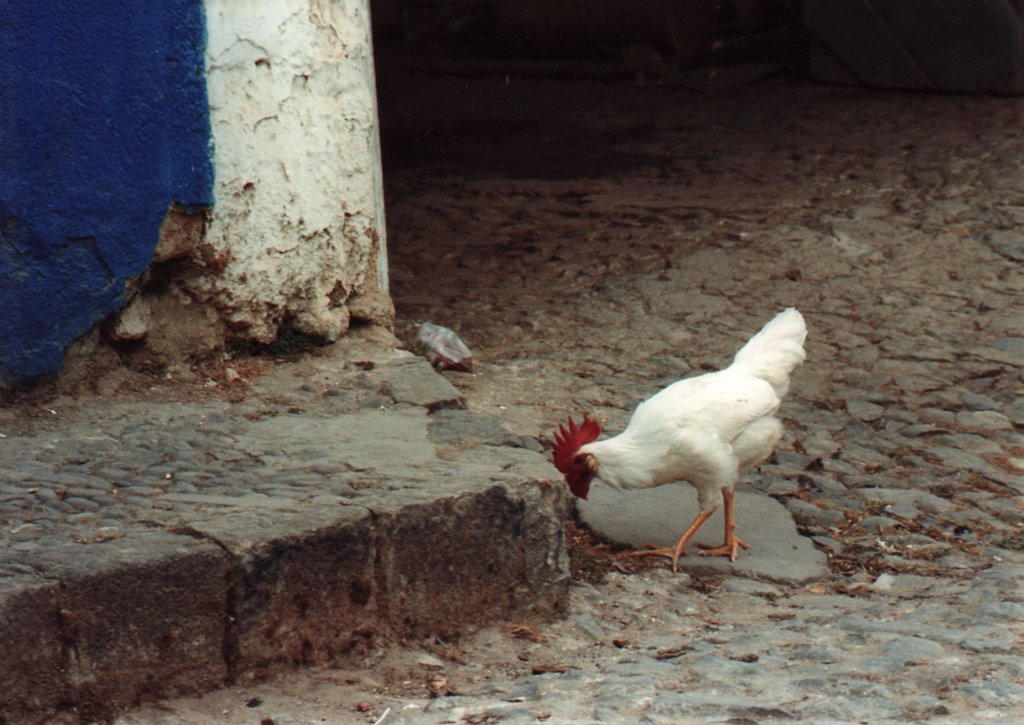
Roosters give their morning call – the sky is so blue.
To be here, is to humble oneself, to simple oneself.
A young girl sits outside on the steps of the clinic. Her hair in a braid like my own, I sit down and ask her name. Julisa is five years old, and when I ask her if she likes school or dancing she gives me a funny look and giggles at my poor Spanish grammar. She talks of her family: her younger brother, mother, and father. She squints and looks down from the midday sun. She explains to me that her father is a migrant worker in Florida. When I ask her, again in poorly formed Spanish, what she wants to do when she gets big, she tells me she wishes to be “una trabajadora emigrante, similar que mi papa.” “A migrant worker, like my dad.”
Wednesday 3-24-2004, further on in time
I helped Bill pull a few teeth… wait just one on her.
She was ten, I think, and her mother had the biggest grin on her face I have ever seen.
I told her in her language I liked her pink pants, and that they were such a pretty color.
It was as simple as that.
I saw her in the clinic the next morning, and she was so excited just to see me again.
I helped pull her tooth the previous day and had only said hello – almost nothing,
yet when I asked her how her tooth was feeling, and her mother said it was healing beautifully as she hugged me and kissed me.
I only told her I liked her pants.
She was wearing the same ones that next day.
“Sometimes you wish you could do more.”
I find frustration as the week concludes. We’ve seen so many people, but we haven’t seen everyone who is waiting. We will be leaving, and many of the beautiful faces in the lines will not have the chance to be given what they so desperately need. What will happen to them over the next years? Knowing they will continue living in the manner they always have, I am deeply pained as I realize I am simply returning to my comfortable life, a plane flight away. The reality of the world’s imbalance seems to uncomfortably settle into my being. Why is my situation the one with the car, and the doctor father, instead of among the farmer families of Guatemala?
Yet, as my father and I sit outside on a cool night before we leave, he tells me something that I will always remember. “Kels,” he says, “I know you want to change the world. But I also know that you can’t do it all at once. It doesn’t work that way. You have to be satisfied with what you can do now. Look at the hundreds of people we saw this week. We made their situation a little better, and that’s all we can ask for. We’ll come back next year, and there will be more work to do.”
As I return to school caged, but consciously grateful for my opportunity, one afternoon I find a small scrap upon the dirty tiled floor of my high school. It is a quote, now taped among my journal writings from my stay in that breathtaking, mountainous country.
“We must not, in trying to think about how we can make a big difference,
ignore the daily difference we can make
which, over time, add up to big difference that we often cannot foresee.”
– Marian Wright Edelman
Subscribe to:
Posts (Atom)