Saturday, December 6, 2008

From Origin to the Disconcerted Consumer

As Published in the Specialty Coffee Chronicle, October 2008


The previous day's sunburn was causing my nose to peel as I climbed the hill behind the William Botnan Learning Center in Santa Avelina, Quiche (Key-ché). I’d lived in Guatemala before, but my skin, white and snowy from the Minnesota winter, has always burned in highlands of the country. It was January, and as I reached the hill’s plateau, I met an Ixil (e-sheel) woman raking coffee beans in the sun.

Though only the size of Tennessee, Guatemala’s diversity is remarkable. Twenty-eight languages are spoken among its ancient Mayan peoples; women wear hand-woven blouses and skirts according to the region in which they reside. The topography ranges from western mountain ranges to southern beaches and eastern jungle where ancient pyramids in Tikal
still stand from the fourth century BCE.

Santa Avelina is located near Nebaj in the Ixil triangle of Guatemala. It was in this mountainous area that some of the gravest atrocities occurred during a 36-year civil war that officially ended just a decade ago. The area on the hill in which I stood was roughly the size of a soccer field, and half of the space was filled with tarps of beige beans. Children from the school giggled and scattered as I crossed the field’s drying, brown grass.

Surprised as I greeted and approached her, the woman put down her rake. She told me the beans were compiled between her and her neighbors and that she received seven quetzales per pound of green coffee. I converted the price to dollars and realized she was earning roughly 90 cents for her work.

Her clothing was rumpled and she wore a faded blouse. Its lavender color matched the purple in her plainly woven skirt. She was barefoot. She smiled as she handed me a fistful of green-gray beans, peeling away their tissue paper skin. “Smell them,” she said through crooked teeth. Unroasted, the aroma was faint but marvelous.

I return often and the country is always familiar, but this woman and her beans remain a vivid memory among the colorful, amicable people of Guatemala’s countryside. But this scene is mundane for those who travel regularly to origin—an ordinary business trip in the specialty coffee industry. You who work at the top of this industry understand coffee’s standing as the world’s second most traded commodity. You see that matters of sustainability are entwined with the production of a quality bean and product. You know fair trade to be one option, but not necessarily the perfect or only option to remedy poverty among coffee farmers. Understanding these ideas is essential to the successes of your businesses. Yet the stronger issue is that the consumer rarely understands anything at all.

Last weekend, a friend of my father’s—a Peet’s coffee devotee—was astonished to learn her beans begin as fruit on a tree. A round, fervent woman with stylish glasses and an asymmetrical haircut, Geri organizes charity benefits and travels annually on medical missions.

“You’re kidding,” she said, and urged me to tell her more.

As I continued, she interrupted, saying, “You mean you can actually eat the cherry?”

An eavesdropper then entered the conversation.

“You know, I love a good cup of coffee, but it’s those flavored coffees that just aren’t quality.” It was of no use to explain that a bean’s flavor actually varies according to its tree, growing conditions and origin.

I’ve had such a conversation before, and most who regularly drink coffee know nothing about it. Often, a habitual coffee consumer is genuinely confused and, when prompted, cannot explain how coffee certifications like Rainforest Alliance or Fair Trade function to provide a more sustainable product.

This is the problem I see: While those involved in the business of specialty coffee understand the intricate network of coffee supply, consumers rarely have enough information to make purchases based upon their own beliefs about farming and sustainability. Because of this, they often look at the price of a pound of coffee and take whatever seems less expensive without understanding that their purchase has a direct effect on the farmer. Either that, or they cannot decide between
the coffee that claims to help an endangered hamster in Tanzania or the other that is marked with a photo of diminishing rainforest. They think, “Is one better than the other, or is it an advertising game?” Stores sell bags of coffee labeled according to regions in distant places a customer cannot often locate on a map. Origins are far away from storefronts and colorful displays, and such places are an incomprehensible part of the world to the majority of coffee consumers.

I consider myself lucky to have happened upon the Guatemalan woman I met in January. Because of her, I have sought conversations about quality, cupping and certifications with individuals directly involved in the specialty coffee industry; I see more than precise packaging and keen advertising when I ask for a pound of coffee. I see the woman’s bare feet and remember how dusty my feet had become in my own sandals that afternoon. She wasn’t just another indigenous woman fighting to stay afloat. She was my connection to origin, and somehow, not such an unfamiliar stranger.

In a city like Minneapolis—where neighborhood communities have distinct presences—frequenting local mom and pop coffee shops is easy to do. Whether known as an artsy hiatus or for its local produce, each neighborhood has its correlating cafés, and while common chains also spatter the sidewalks, I am able to make my own choices about the coffee I drink. But I am able to make these choices because I understand that purchasing coffee is more complex than laying two dollars down on the
counter.


In frequenting new places, knowing the right questions to ask is essential: Where are these beans from? Do you know the farm? The farmer? What is their quality, and how much was paid for them? Even if they are not certified Fair Trade, what can you tell me about the condition in which they were grown? Unless the owner of the shop is present, though, the area is usually gray.

I’ve also found that firing any number of these questions at a barista can be particularly overwhelming—especially for the one who got the gig as a summer job and is just learning to pull a shot of espresso. Because of this—that many of these baristas do not know about the beans they are preparing—I find myself clinging only to fair trade or others that are advertised with a certification in cafés. There are other, unmarked options for sustainable coffee, but if a barista lacks knowledge about the shop’s practices, I have no other option than to choose the brew that is certified and labeled.

It seems, then, one solution for the confused consumer relies in part on the barista who prepares his or her coffee. If baristas are well versed in the espresso they pull and can engage a customer in a conversation about it, we have found a way to both incite a consumer’s personal interest in his or her coffee and bring light to the system itself.


Kelsey Kudak is a senior at the University of Minnesota pursuing a bachelor’s degree in English and dance with minors in photography and journalism. She grew up in St. Cloud Minn., and moved to Minneapolis in 2005 to begin her successful undergraduate career. After moving to the Guatemalan highlands to volunteer as a medical translator in 2007, she realized her interest in the coffee industry was intimately tied to her time there. She is currently focusing on the education of the coffee consumer while writing her undergraduate thesis, “Exposing Cherries: An Examination of the Coffee Supply Chain in Light of the Fair Trade Industry.”

Monday, September 22, 2008

A bridge anew.

It was quiet. Punctual.

The gathering on the sidewalk on Thursday morning was small: a cluster of media, students in sweatshirts on foot. Bleary-eyed bikers perched on pedals and frames as their taillights blinked in unison with those of the adjacent dump trucks at the intersection. As a MN DOT worker clad in neon climbed into his dump truck, a sign above his rig read, “Stay back. Stay alive.”

State troopers removed their cars from a makeshift barricade, and turned their headlights north to the river. Moments later, a simple progression of vehicles rolled down a ramp from University Avenue. The morning was cool, and streaks of dawn were somewhere in time’s impending distance. A slope of tripods dotted the hill toward the interstate; shutters clicked. Camera phones were held in the air.

From the ramp, traffic flowed to form five lanes streaming southbound that were met halfway by others heading opposite. As they passed waving markers lit by LEDs, those in vehicles were suspended on a white concrete cloud above the Mississippi.

And then they had crossed the bridge.

The general stillness had broken by bleats of horns in the moments before—some short blasts, others long and blaring. Helicopters chopped at the air suspending them above the river. A few cheered as if we’d conquered something.

We’d built a bridge in record time. But it was a bridge that required no groundbreaking ceremony because its ground had already been broken. There was no unveiling because the project hadn’t ever had a covering to keep its progression a surprise.

But since its reinception after the I-35W bridge crumpled and fell, passersby have paused on 10th Avenue to gaze over the gap at what was wrecked in the river. First it was gawkers who “came to see for themselves,” and then locals began to watch its progress as workers embarked on a round-the-clock regimen. Ceremonies had surrounded the bridge’s tragedy and anniversary while renewing the strength of the city of Minneapolis. Commemorative artwork had been commissioned and realized in brushstrokes that depicted the “Thirteen Flowers” lost when the first bridge collapsed in a matter of moments.

What is it that draws the city of Minneapolis to this new bridge, and the memory of the other? Bikers on the 10th Avenue Bridge are perpetually stopped in contemplative states along the wired fence that held the new bridge plans. The community had voted on the design of the bridge: its efficient LED lighting system and, sound, protective technologies. Families have crossed the path to take photographs and portraits along each part of the building process. Observing the bridge, and the research surrounding its failure has been the city’s greatest spectator sport for the last year.

We continue to ask ourselves, “How does a bridge fall down?” and “What prevents any other bridge from doing the same?”

The new bridge has superb technology, and was carefully created in spite of 24-hour work and daily glitches. Three hundred twenty-three sensors have been installed in the bridge; some reside inside its concrete. According the Minnesota Public Radio, these will examine changes over time, and measure how much and how quickly the bridge moves as traffic travels across it. Other sensors keep track of temperature and corrosion. MPR continues to note that one of the only other bridges with such technology is the Golden Gate Bridge in San Francisco, but the sensors on our St. Anthony Falls bridge outnumber the Golden Gate’s by 150 or so. Additionally, the Golden Gate spans 1.7 miles, whereas our bridge is just 504 feet.

The information gathered by these sensors doesn’t have far to travel as specialists at our own university will be examining the data for the Minnesota Department of Transportation. Mn DOT will be able to monitor early problems immediately, making the new bridge one of the safest and most closely monitored bridges in the nation.

The bridge was built with a higher strength, higher performance concrete. Its plans say it should last a hundred years. Gusset plates were replaced with steel tendons, making the bridge more human in some way. Its redundancy is sound.

We can tell ourselves the technology will keep us safe. But regardless of these advances, it is because this tragedy happened within such normality that it remains so fervently haunting: a beautiful August day with hints of fall in its air. The end of the workday had come, and many were traveling home with dinner in mind. At the interfaith service at the Basilica of St. Mary on the anniversary of the collapse Methodist Bishop Sally Dyck, President of the Minnesota Council of Churches, spoke to this. “We cross bridges every day,” she said. “And I’m not speaking in metaphor.”

For those in the proximity of this bridge, for those who have heard the sounds of pounding planks and poured concrete for the last year, the neighborhood suddenly seems quiet. The noises of its progression, and fighting traffic on alternative routes have become the background of daily life.

Though traffic remained sparse at 5:20 on Thursday morning, the quiet of a regained normalcy resounds more loudly than cars that cross the sweeping width of a new bridge.

Sunday, July 20, 2008

Missing Roses

So I've been on a bit of hiatus. Not from writing, but from writing here. I could offer up my excuses and say that I've been pursuing credits toward my B.A. in Dance for the last three weeks (which is true). Or I could note that I've been taking notes as a reporter and photographer for a couple of local bi-monthly papers (also true).

But to be honest, I just haven't written--haven't known what to write (perhaps untrue).

I still don't, but I do have something to share. It's a piece of writing I tinkered with over Spring semester of last year, a piece about my grandmother Rose who passed away this week. The piece remains unfinished, but since its beginning, it has functioned as a lens with which to view what was happening to my grandmother's deteriorating health. To consider how I might write the scene I was living was my way of getting beyond what was really happening.

And even in the quiet of Thursday's dawn, as she lay in lavender pajamas, breathing shallowly beneath a hand-stitched quilt, I was writing. Taking notes, remembering times, smells and the way the light shone on her quiet face. I was writing from a fragile necessity that morning.

But the piece. It was edited some for a space constraint and I haven't refilled in the spaces I cinched together for class. But I'll stop with the explanations and excuses.


From "The Destrcutors"


Last Christmas Eve, the house had been filled with family and friends who appeared annually for the holiday. From my seat at the bar I spotted my grandmother and my uncle’s mother in a corner where both women seemed younger versions of themselves.

Lois and Grandma were perched on the couch, their arms entwined. I watched as they laughed; their heads of grandmother curls doubled over and the women came up with wet cheeks. She looked different from the way I remember her as a kid; she looked different from the way I had thought of her lately. Her wrinkles and frailty had recently overwhelmed me. And she had finally succumbed to the idea of Chandler place.

Jan walked to the center of the room and tinkled the glass containing her own drink, “Rosie has a little something to say to everyone.”

The men in the room began to shout obnoxiously: “SPEECH! SPEECH!”

“OOkay, Shutchyour damn mouths.” Grandma spoke from the back of her throat and ambled to her feet before laughing and then letting tears fill her eyes as she looked around the room. Her lips pursed and her face smushed in creating the kind of silence that exists before a child cries after he falls.

She sniffed and her words came in spurts. “I just… want to… wish everyone a Merry Christmas… and… thank… you all for… coming.” She’d had a speech prepared, but faltered. “You all know what you mean and you all have the memories so I don’t need to bring them up.” Looking small and frail, she raised her drink in the middle of basement. Her clothing was rumpled as much as her face, and the tears trickled down before her last sentence came out in one breath. “You all have a good time,” she said and eased slowly toward the couch before collapsing onto its cushions. Lois patted her on the back. Her voice sounded naturally congested.

“You did great Rose.”

That was to be the last Christmas Eve at 3511 NE Main.


I sighed and rubbed a finger through the dust on the horn-rimmed glasses pinned to the bar by a thumbtack. They had brought on the memory and their joints had been crudely repaired with stiffened hot glue. The hardened material held them open as if Grandpa had removed them for a moment to chew on the edges while he mixed a drink. They remained the glasses Paul Auster’s father left behind: “scattered throughout the house: on kitchen counters, on tabletops, on the edge of the bathroom sink—always open, lying there like some strange, classified form of animal.”

“There is a poignancy to it, and also a kind of horror. In themselves, the things mean nothing, like the cooking utensils of some vanished civilization. And yet they say something to us, standing there not as objects but as remnants of thought, of consciousness of the solitude in which a man comes to make decisions about himself: whether to color his hair, whether to wear this or that shirt, whether to live, whether to die. And the futility of it all once there is death.”

I read these lines only a day after my aunt’s voice pulled me from the place where the glasses hung near the bar. I climbed the carpeted stairs to the kitchen.

“Grandma wants to know if you want her china,” she asked. The kitchen was filled with boxes and the cupboards were wide open, their gutted insides spread over the countertop. Newspaper and old towels were intermittent with vases and candy dishes.

“Sure, but you’ll have to send it with my parents. I have no room for it in my apartment.”

As Grandma pushed on the table’s surface to stand, her navy corduroys fell back around her ankles and re-covered her bony legs. She carefully started in the direction of the adjacent living room, clinging to the walls and its doorway for support.

I said, “Thanks Rosie,” and she turned to me.

“Oh you’re welcome.”

“How’re you doing?” I asked, rubbing her back.

She answered with a singsong, “Oh I’m fine.” But as she turned on the TV, I can only presume how she really felt. Perhaps that she missed my grandfather more than I’d ever understand. Perhaps that she was giving up, surrendering to the move. Feeling obligated after such a stroke.

She’d be giving up her car, no longer trusted to drive. Giving up her house, where she’d raised two children and buried and third, days after her birth. Where she’d washed dishes and forced my father to eat beets at the kitchen table after they’d gone cold. She was always cold now, wearing sweatshirts year round. There was a time when climbing the stairs was not an event and she made kool-aid in a crystal pitcher on summer afternoons for her kids.

As she looked up from the television, she might have remembered a time when she could see for miles from the front window, before someone from train yard across the street had built up the earth and created a man made hill to deafen the sounds of trains at night. But the freight cars on their tracks were still audible during the early hours of the morning, even though it was decades ago their whistles stopped registering in her ears.

• • •

The huge prints of Grandma and Grandpa on their birthdays’ were framed in the basement and hung above the end table holding an old rotary telephone. On her head of curls, my grandmother had a birthday crown made of tin foil. In his, Grandpa was wearing an enormous sombrero and grinning. Though the photograph is noisy and soft, the black frames of the glasses on his face seemed to jump out of the relatively gray scene.

I twisted the screwdriver to the left, loosening the lower corner of Grandpa’s frame on the wall. The rough wood poked a sliver into my palm and I held the frame steady. It left a growing red spot as I ignored it and continued to dismantle the frame, detaching it from the wood paneled wall.

Screw after screw, I loosened and removed, until I could no longer reach the tip of the Phillips flush into its screw.

I dismantled the frame in a methodic nature that reminded me of Graham Greene and Mr. Karn’s tenth grade AP lit class. We’d read ‘The Destructors” during the term, and I would recall it six years later when I was dismantling my grandmother’s house. Though my father and I had not been destroying the floorboards of an old man’s beautiful house, new paint covered cigarette-stained walls and the year-round tinsel and Christmas lights in the basement has been thrown in the trash.

“Dad, will you help me with these last screws? I’m not tall enough.”

• • •

“I went down to dinner today,” Grandma told me over the phone. “But it wasn’t so great.” She’d taken to eating dinner with a new group of women. They flock down to the ornate social room for happy hour, but Grandma turns her nose up at the fact she’s only allowed two vodka cokes.

“How are your new lady friends?”

She giggled, “Oh they’re fine. Just fine.” Even though she was in her apartment alone, her voice dropped, indicating gossip. “But there’s the one lady… oh she bugs me. She’s just a little bit… slow, you know. And I know I shouldn’t say that, but every time I see her I just get so upset. She’s completely senile…”

“I know what you mean,” I said. “Did you go down to happy hour today?”

“No, that’s only on Friday. So tomorrow the Helen and I will go. We like to get together and… toss the air. So what are you up to tonight, Kels?”

I briefly recount the relentless details of my semester’s end and three jobs.

“Goodness. Don’t get yourself all tired out now. You’re so busy, I just worry about you sometimes.”

Thursday, June 12, 2008

And they say it's not just a trend.

I found this in Wednesday's edition of the New York Times.


UPDATE: Yesterday, (meaning Friday) I mentioned this to my coworkers at the restaurant in which I work. One particular coworker seemed he would defend the organic vodka to his grave - that it not only greatly differed from other vodkas, but that even after the distilling process it was more fresh. (Though when I think of vodka in general, I have to say that fresh isn't among the first descriptors that come to mind). It's too bad I prefer rum, otherwise I'd challenge his theory. Well, that, and the fact that drinking alone implies certain social shortcomings from which I'd prefer to stay dissociated.

Thursday, May 29, 2008

eavesdropping in the waiting room

"I bought a great vintage frame in a rummage sale a few weeks ago, and my husband needs to finish building my new commuter bike. But in the meantime, I'm riding this heinous dog-walking mountain bike."

Saturday, May 24, 2008

And then I looked at the cover: the yellow margins, the date.

I've just begun reading Bill Bryson's The Lost Continent: Travels through small town America.

After what is a standard beginning for most books--acknowledgements, publication, dedication and title (each prescribed with a miniscule roman numeral)--Bryson's prose begins on page three. By page seven he has managed to successfully coerce an audible laugh from me (which, when you're reading amidst a group of people in a crowded shop is a commendable feat in itself), and bring me to a place it seems all young kids avouch for early recognition of the larger world around them: National Geographic.

Though Elizabeth Bishop certainly published this notion years ago, its validity remains universal without epic or further publication; I am writing here, in an untrafficked place, with my own modest memory of the magazine.

I played piano from the age of six until I was a sophomore in high school, and practicing the keyed instrument was my least favorite part of the day. I'd tinker with Bach's Minuet in G, and thereafter avoid my Suzuki book entirely. Instead, I supplemented the classics with rags or jazz I'd memorized months or years before, and afterward, would slip from the corduroy cushion on its bench to the storage cupboards next to the piano. In addition to old photo albums from my parents' college years, the cupboards housed an archive of National Geographics aligned by date. Their spines created an overwhelming rectangle of gold when I climbed atop the bar's counter to open the narrow door next to the windows of the wine cabinet.

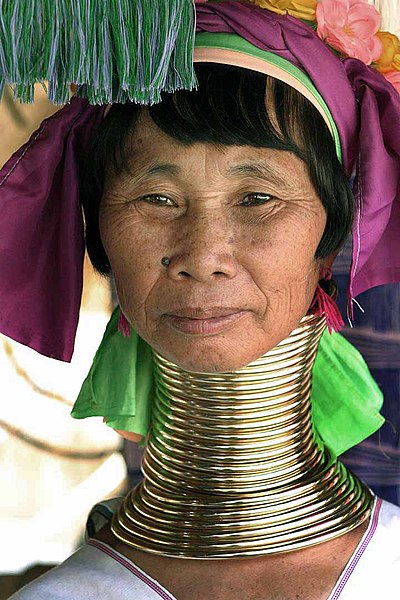
One afternoon, as I avoided Vivaldi and went to the cupboard, a Kayan woman with golden rings around her neck stared at me through the golden frame of the cover. As a child of probably six or seven, I was astonished. The necks of her and the other women were "wound round and round with wire like the necks of light bulbs". Sitting cross-legged on the carpet and devouring other photos of the giraffe woman, I didn't understand the physics or the medical nightmares that occurred when the clavicles of the woman were crushed and the apparatus rendered her neck muscles so weak they could no longer support her head without the device. This beauty was painful, but I only imagined the place in which she resided. It was so far removed from anything I'd ever seen, its actual existence was unfathomable.

When I asked my mother about it, I'm sure her reply was something about other cultures having different perceptions of beauty--which is why even the small children in the magazine had pierced ears and I had to wait until my eighth birthday to have my lobes punctured. But I considered myself lucky because my best friend Karen was waiting until thirteen, an age tardy by both her standards and mine.

When my time came, I discovered my allergy to nickel and other inexpensive metals and the healing process had been a mess. My ears became pussy, bloody and painful when I exchanged my original stainless steel studs with golden ballerinas, and, from then on, I was forced to don the plain jewels reserved by the "sensitive ears" section of Claire's.

But I've digressed from the point.

The floundering magazine that was created in 1888 to increase the "diffusion of geographic knowledge" was supported by Alexander Graham-Bell's father-in-law, and originally read like a textbook. It wasn't until photographs were a haphazard addition to an edition in 1905 that our country, from Bill Bryson and Elizabeth Bishop, became and remained entranced by the worlds in its pages they would have otherwise never been able to see. And that's where Bryson left off when I bookmarked page fourteen to write this: with his desire to leave his hometown of Des Moines, Iowa and move to England. And he did. But his following pages are not of the places he discovered in his years abroad; they are a rediscovery of our own and his own small town escapades.

But perhaps I'm making a grandiose statement prematurely. Giving a book fourteen pages is like judging its cover, even though I'm looking forward to giving Bryson a few more days.


" I began to read--no, I began to consume--National Geographics, with their pictures of glowing Lapps and mist-shrouded castles and ancient cities of infinite charm. From that moment, I wanted to be a European boy. I wanted to live in an apartment across from a park in the heart of a city, and from my bedroom window look out on a crowded vista of hills and rooftops. I wanted to ride trams and understand strange languages. I wanted friends named Werner and Marco who wore short pants and played soccer in the street and owned toys made of wood. I wanted my mother to send me out to buy long loaves of break from a shop with a wooden pretzel hanging above the entrance. I wanted to step outside my front door and be somewhere."